GRC Compliance Management has become a strategic requirement for enterprises operating complex SAP landscapes. As regulatory expectations increase and audit scrutiny intensifies, organizations can no longer rely on fragmented tools and/or controls, manual reviews, or disconnected risk assessments. What is required is an all-in-one SAP GRC tool that delivers unified, continuous, and enterprise-grade Governance, Risk, and Compliance.
The modern SAP GRC suite provides comprehensive coverage across access governance, risk analysis, compliance monitoring, audit management, and control assurance, enabling organizations to minimize threats, reduce exposure, and demonstrate regulatory compliance with confidence.
Why GRC Compliance Management Must Be Centralized in SAP
SAP environments are inherently complex. Risks do not exist in isolation; they emerge from the interaction of users, roles, authorizations, business processes, and data. Without centralized grc management, enterprises struggle to answer fundamental audit questions such as:
- Who has critical access?
- Which risks are mitigated versus accepted?
- Are access reviews meaningful and evidence-based?
- Are controls operating effectively across systems?
- Are the change logs protected from tampering?
- How data is being utilized? How it is classified?
An integrated SAP GRC solution addresses these challenges by consolidating risk identification, mitigation, governance, and assurance into a single compliance framework. This is the foundation of effective SAP governance, risk and compliance.
SAP GRC Suite as the Backbone of GRC Compliance Management
A true GRC suite is not a collection of disconnected tools. It can’t be a simple SoD Analyzer, Risk Mitigation engine, or a Simulator. It is not even an on-the-shelf software that can be deployed as an Antivirus solution. GRC suite must be a unified platform that supports the full compliance lifecycle, from prevention to detection, mitigation, and assurance. Here is the modern SAP GRC Suite by SAP:
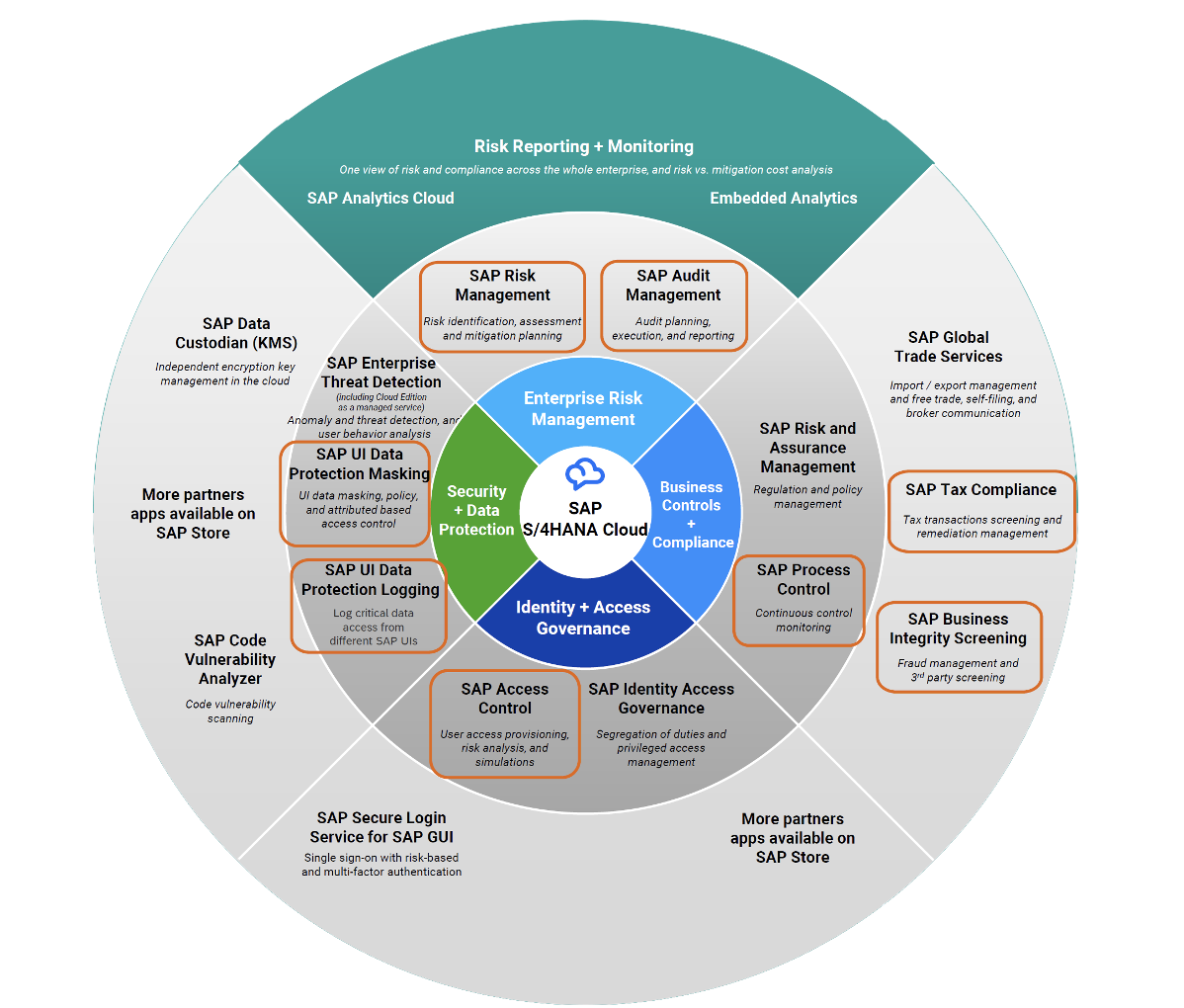
Image source: SAP
By design, the SAP GRC suite enables organizations to operationalize SAP governance risk management and compliance across IT, security, risk, audit, and business teams. Each component plays a distinct role while contributing to a common compliance objective.
SAP Access Control: Controlling Risk at the Source
Access is the primary entry point for risk in SAP. SAP GRC Access Control ensures that access provisioning, changes, and reviews are governed by risk-aware decision-making rather than operational convenience.
For example, when a user is assigned roles that together enable vendor creation and payment processing, the system performs real-time SAP Risk Analysis to identify the Segregation of Duties conflict. Instead of discovering the issue during an audit, organizations can address it immediately through role redesign, access removal, or documented SAP risk mitigation. This proactive approach is fundamental to SAP security and GRC, particularly for enterprises subject to SOX compliance in SAP.
SAP User Recertification as a Compliance Control
Periodic access reviews are one of the most visible compliance requirements, yet also one of the most poorly executed. Manual, spreadsheet-driven certifications often result in rubber-stamp approvals and weak audit defensibility.
Within a mature SAP GRC tool, SAP user recertification becomes a structured governance process. Reviews are risk-driven, context-aware, and fully auditable. Business owners are presented with clear visibility into user access, associated risks, and historical usage, enabling informed certification or revocation decisions.
This directly strengthens SAP governance while reducing long-term access risk.
SAP Risk Management: From Technical Violations to Business Impact
While access analysis identifies technical risk, SAP risk management ensures that risks are evaluated in business terms. Not all risks can be eliminated immediately; some must be consciously accepted due to operational constraints.
A robust SAP GRC system allows enterprises to document, assess, approve, and monitor risks over time. Risk ownership is clearly defined, approvals are traceable, and residual risk is continuously evaluated. This disciplined approach is essential for effective grc for sap implementations, particularly in regulated industries.
SAP Risk Mitigation and Control Assurance
Risk acceptance without mitigation is a common audit failure. SAP risk mitigation ensures that when access or process risks exist, compensating controls are in place and operating effectively. For instance, critical access granted to support teams can be mitigated through monitoring controls, post-activity reviews, or automated alerts. These controls are linked to risks, tested periodically, and supported by evidence, creating a defensible compliance posture.
This integration of risk and control execution is a defining characteristic of enterprise-grade SAP GRC security.
SAP Process Control and Continuous Compliance
Compliance is not achieved through access controls alone. SAP Process Control ensures that financial, operational, and IT controls are designed correctly and functioning as intended.
Controls related to journal entry reviews, master data changes, or system configurations are documented, tested, and certified within the GRC framework. When combined with Access Control and Risk Management, Process Control provides end-to-end coverage for SAP governance risk and compliance.
SAP Audit Management: Always Audit-Ready
Audits should validate governance, not disrupt operations. SAP Audit Management enables organizations to plan, execute, and track audits within the same SAP GRC suite that manages risks and controls.
Audit findings are linked directly to underlying risks and controls, remediation actions are tracked to closure, and evidence is readily available. This eliminates last-minute audit firefighting and supports continuous grc management.
SAP Security and GRC: A Unified Operating Model
When implemented cohesively, the SAP GRC modules create a single operating model for SAP security GRC. Access provisioning, risk analysis, mitigation, recertification, process control, and audit are no longer separate activities; they become interconnected governance mechanisms. This is what differentiates a tactical sap grc tool deployment from a strategic SAP GRC solution.
Business Value of an All-in-One SAP GRC Tool
Enterprises that adopt an integrated GRC SAP module approach consistently achieve:
- Reduced audit findings and remediation effort
- Stronger control over SAP critical access
- Improved visibility into enterprise risk
- Sustainable SOX compliance in SAP
- Scalable governance for growing SAP landscapes
Most importantly, they move from reactive compliance to proactive SAP governance risk management and compliance.
Final Perspective
GRC Compliance Management is no longer about satisfying auditors. it is about protecting the enterprise. A unified SAP GRC system enables organizations to minimize threats, manage risk intelligently, and maintain continuous compliance without slowing down the business. By leveraging the full SAP GRC suite, enterprises gain a powerful, scalable, and defensible GRC compliance program that supports long-term growth, resilience, and trust.